
Taylor Jung · 20 October 2026
Poland's University Reforms Spark Widespread AI Tool Trials Among Lecturers
Reforms targeting lecturer evaluation and professional development in Polish universities have led to increased experimentation with artificial intelligence tools in classrooms since early 2025, and observers note that these changes continue into October 2026 as institutions adjust curricula and teaching methods. Data from the Ministry of Science and Higher Education indicates that over 120 departments across 45 public universities now incorporate AI platforms for personalized feedback, automated grading assistance, and interactive content generation, while researchers track participation rates through national surveys conducted each semester.
Background on the Reforms
The evaluation framework introduced in 2024 shifted focus from traditional publication metrics toward teaching innovation and digital competence, which prompted lecturers to explore AI solutions as a practical response to updated performance criteria, and this approach aligns with broader European efforts to modernize higher education. According to figures released by the European Commission, Poland ranks among the faster adopters of such tools within the European Higher Education Area, with implementation rates rising 28 percent between 2024 and 2026. Universities in Warsaw, Kraków, and Wrocław report the highest activity levels, whereas smaller regional institutions follow at a steadier pace due to varying access to technical support staff.
Current Experiments in Classrooms
Lecturers at several institutions have integrated AI writing assistants into composition and language courses, where students receive immediate suggestions on structure and vocabulary while instructors monitor usage patterns through built-in analytics dashboards. In science faculties, simulation software powered by machine learning models allows real-time adjustment of lab parameters, and one study from the University of Warsaw documented a 15 percent improvement in student comprehension scores after one semester of use. Business programs experiment with predictive analytics tools that generate case study variations based on current market data, enabling lecturers to update materials weekly without extensive manual preparation.
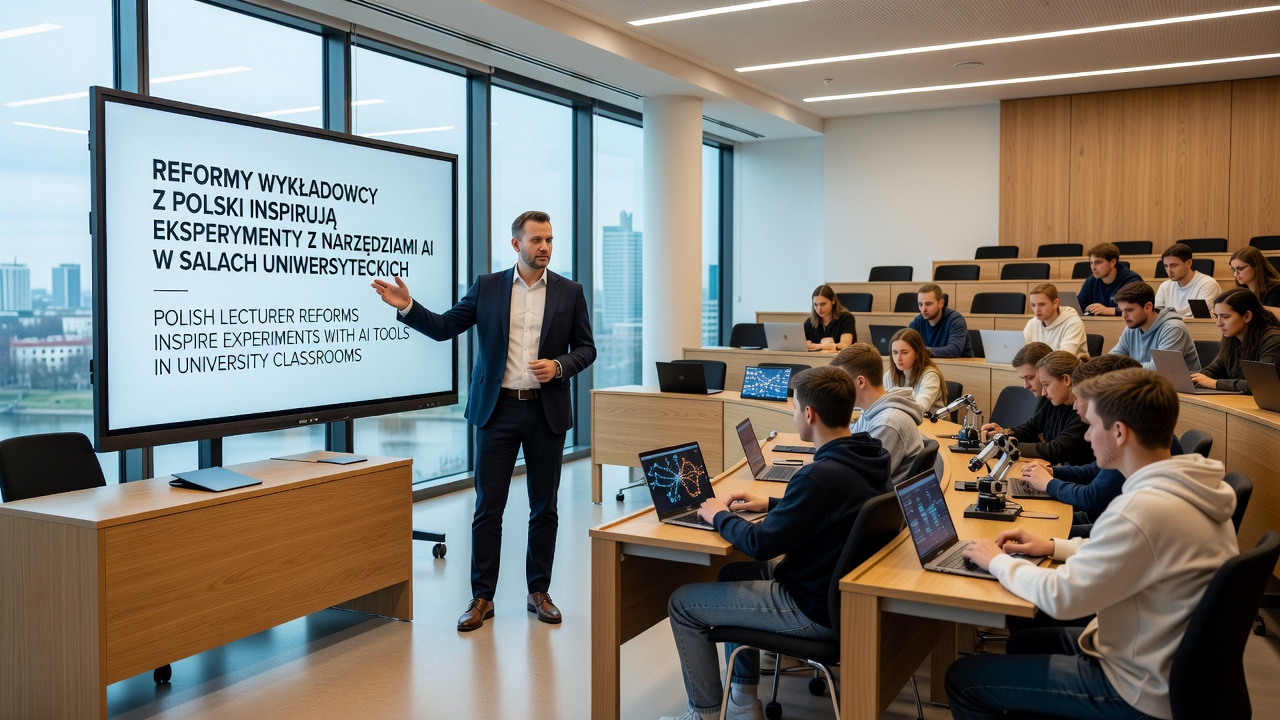
These trials often combine multiple tools within single courses, and data shows that 67 percent of participating departments now require students to complete at least one AI-supported assignment per term. Training sessions organized by university centers for teaching excellence provide hands-on workshops, yet participation remains voluntary in most cases because the reform guidelines emphasize flexibility over mandates. Researchers at the Jagiellonian University continue to collect longitudinal data on student engagement, noting that initial resistance among some lecturers has declined as peer demonstration sessions highlight successful implementations.
Measured Outcomes and Ongoing Adjustments
Early assessments reveal mixed but measurable results across disciplines, with language departments reporting quicker turnaround on feedback loops and engineering programs noting enhanced project collaboration through shared AI workspaces. A report published by the OECD highlights similar patterns in several member countries, suggesting that targeted lecturer reforms can accelerate adoption when paired with institutional resources for tool licensing and technical training. Polish universities have formed informal networks to share best practices, and meetings scheduled for late October 2026 aim to standardize data collection methods for cross-institutional comparisons.
Challenges include ensuring equitable access to premium AI features and addressing concerns about academic integrity when students use generative tools for assignments, so ethics modules now appear in many course outlines. Lecturers who participated in pilot programs describe workflow changes that free time for deeper discussion rather than routine grading, although full integration still requires ongoing technical updates and policy clarification from university administrations.
Future Directions
National funding allocations announced in mid-2026 support further expansion of these experiments, with priority given to projects that combine AI tools with inclusive design principles for students with diverse learning needs. International partnerships, including exchanges with institutions in Canada and Australia, provide additional benchmarks for evaluating effectiveness, and joint webinars scheduled through the end of the year focus on scalable models that other countries might adapt. Observers expect continued growth in tool variety as new platforms enter the market and Polish universities refine their internal guidelines.
Conclusion
The combination of reformed lecturer evaluations and practical classroom trials has created a structured environment for AI experimentation in Polish higher education, and available data through October 2026 shows steady rather than rapid expansion across participating institutions. Continued monitoring by research teams and alignment with European frameworks will shape how these initiatives evolve in the coming academic years.